
What to do if someone faints: First aid guide
Imagine you are in a queue, sitting at work or chatting to a friend when, suddenly, the person next to you turns white and faints. For a few seconds, everyone starts panicking. Someone gets a bottle of water out. But those first few seconds after someone faints can be critical and a composed, simple response can prevent the victim from sustaining a second injury and, crucially, can determine if there is something more serious going on.


On this page
Fainting, medically known as syncope, is the condition of brief loss of consciousness due to a reduction in blood flow to the brain. It can be triggered by heat, dehydration, standing for too long, pain, stress and a sudden drop in blood pressure. But sometimes fainting can also be a symptom of something more serious, so what happens in the first few moments can be vital.
Knowing what to do if someone faints starts with checking their safety, assessing their breathing and recognising signs that require emergency medical attention.
First aid for fainting: Make the area safe

The first step in knowing what to do if someone faints is to keep them safe, prevent further injury and check whether they are responsive. If the person is conscious, but says they feel dizzy, weak, sweaty or as if they are about to faint, help them to sit or lie down somewhere safe to prevent them falling over.
If the person has already collapsed, clear away any objects from the floor that they might hit or which could cause further injury, but do NOT move the victim unnecessarily (especially if you suspect neck or back injury).
When someone faints, the priority is not to panic or immediately give them something to drink. Knowing what to do when someone faints starts with checking that they are safe and responsive.
Check responsiveness and breathing
Gently call their name and touch their shoulders to see if they respond. If they don't respond, check if they're breathing normally. If possible, get someone to call emergency services and bring an AED (automated external defibrillator) if available. Understanding what to do if someone faints also means knowing when normal first aid is not enough and emergency assistance is needed.
- If they're unresponsive and not breathing normally: Call emergency services (112 in India) straight away or get someone else to do it. Start CPR and follow the emergency operator's advice. If an AED is available, use it and follow the instructions.
- If they're unresponsive but breathing normally: Call emergency services if they do not regain consciousness. If there is no suspicion of head, neck or spinal injury, place them in the recovery position and continue to monitor their breathing until emergency help arrives. If a head, neck or spinal injury is suspected, avoid any unnecessary movement and follow the emergency operator's advice.
- If they regain consciousness quickly: Get them to lie down in a safe place. If there are no injuries, elevating their legs slightly can be beneficial, if it doesn't cause them pain or if an injury is suspected.
The recovery position keeps the airway open and helps prevent choking if they vomit. It does not treat the cause of their faintness, so if their breathing becomes abnormal or stops, turn them onto their back if you need to and start CPR (opens in a new tab), following the emergency operator's advice.
What to do immediately after someone faints
A fainting incident is always an attraction for curious onlookers. Ask them to give the patient space. Loosen any tight clothing from the patient's upper part of the body, such as a tie or a collar. Keep the patient's environment as comfortable as possible, instead of asking them numerous questions.
Also, ask them to recall if something had happened prior to fainting, such as standing for too long, being in a stuffy room, or suffering from nausea, dizziness, vomiting, weakness, or chest pain. Ask if they felt their heart pounding or beating irregularly.
What not to do when someone faints
This is one of the most common mistakes that people tend to make. Do not slap the patient, shake them violently or pour water over their face. These actions can do more harm than good and do not treat fainting.
Most importantly, they should not be forced to take any liquids such as water, juice or medicines while unconscious or semi-conscious as it can lead to choking.
Once they are fully conscious and capable of swallowing, small amounts of water may be given, especially if there is a suspicion that dehydration could have caused the fainting episode. There is also no need to rush them to stand immediately, as this can bring the dizzy spell back and cause another fainting episode.
When to seek emergency medical help for fainting
Most simple fainting episodes are short, but the circumstances in which they occur can be important.
Emergency medical assistance is needed if the person:
- Does not quickly regain consciousness
- Is not breathing normally
- Has chest pain
- Has severe difficulty breathing
- Has a very fast or irregular heartbeat
- Has a seizure
- Has difficulty speaking or moving after regaining consciousness
- Has had a serious injury or a significant blow to the head
- Faints during physical activity
- Faints while lying down
- Remains disoriented or does not return to his or her normal state
A serious blow to the head that results in a headache that becomes more severe, repeated vomiting, confusion, unusual weakness, or another loss of consciousness also requires emergency care. If a person does not quickly regain consciousness, this is not the time to watch and wait.
What to do after someone regains consciousness
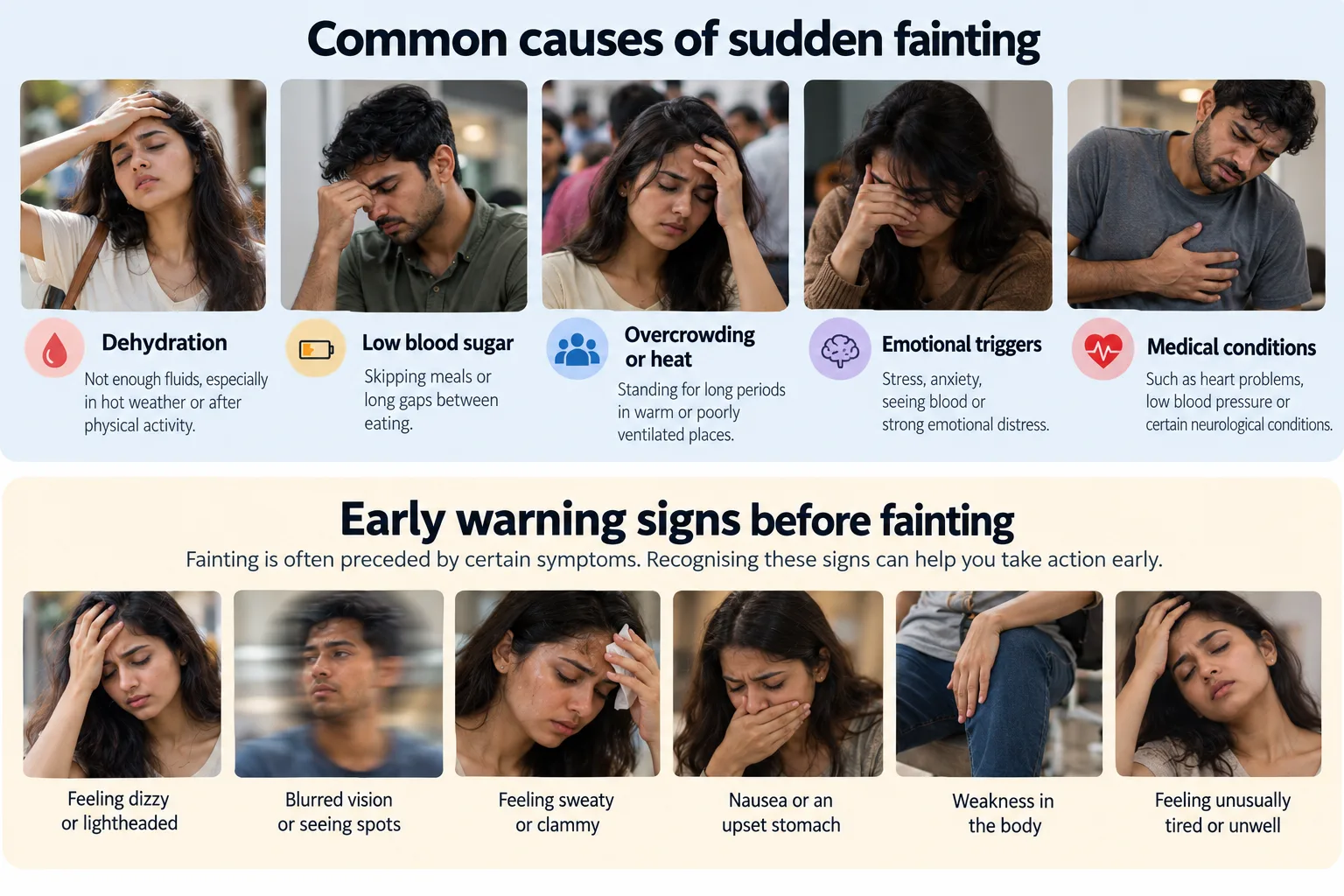
The moment a person opens their eyes, they may tell you that they are alright. They may try to get up and leave immediately like nothing happened. Don't rush them. Have them lay still for a while. If they start to feel dizzy again, keep them down until the feeling passes. Help them sit up once they feel better, and let them stand up on their own if they feel well enough.
After they feel better, ask them what happened. Were they doing anything out of the ordinary before they fainted? Did they eat and drink enough? Were they overheated? Did they feel dizzy or weak before they fainted? Did they feel pressure in their chest, shortness of breath, or a fast heart rate? This could help when they go to the doctor.
Even if they feel fine after they faint, the first time they have fainted on their own or if they faint more than once, they should get checked by a doctor. It could help to figure out what could be happening.
Medical guidance after a fainting episode
Beyond acute safety concerns, medical advice can help guide what to do following a fainting episode.
YourDoc's (opens in a new tab)AI assistant Jivika will use text, voice and image recognition to triage your symptoms and identify possible warning signs. Where relevant, cases can be escalated to involve human medic review or a call to a doctor. YourDoc can also help with emergency hospital discovery, calling for an ambulance or emergency alerts.
That said, AI-guidance is no substitute for emergency care. If the person remains unconscious, or is experiencing abnormal breathing, or other warning signs, seek emergency care right away.
Topics
Related reading
Nosebleed: Causes, First aid and Warning signs
A nosebleed can occur at any time whilst at work, on the move or even when blowing your nose due to a cold. Many will automatically lean their head back or insert a piece of tissue into their nose. However, this may cause more problems. Most nose bleeds are caused by slight irritation and can be treated at home. Knowing what to do when you have a nosebleed and what not to do will help you stop the bleeding safely.
Paracetamol guide: Uses, overdose risks and precautions
Most of us have taken paracetamol at some point, whether for a headache, fever or those annoying body aches that make even a normal day feel exhausting. It's a familiar medicine, often kept in the home and used without much thought. But even a common medicine needs a little care. Taking too much paracetamol or accidentally combining it with another medicine containing the same ingredient can cause serious liver damage.

Fever: Causes, symptoms and treatment
"It's nothing but a fever." A fever is generally a sign that your body is fighting off some kind of infection and typically goes away as soon as the source of the infection has been dealt with. However, if you have a very high or lingering fever, or if it is accompanied by other serious symptoms, you should call your doctor.
This article is for general information. It is not a diagnosis or a substitute for a doctor’s advice. In an emergency call 112 or 108.